

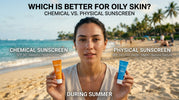
Which is Better for Oily Skin: Chemical or Physical Sunscreen?
, by Hemant Shah, 10 min reading time
, by Hemant Shah, 10 min reading time
If you have oily or acne-prone skin, finding the right sunscreen can feel like a never-ending experiment. You want solid UV protection, but most formulas leave your face looking like a glazed doughnut by noon. The good news is that the answer is less about choosing a "side" and more about understanding how each type of sunscreen for oily skin actually behaves on your skin. Chemical and physical sunscreens work through completely different mechanisms, and for oily skin specifically, that distinction matters enormously. Let us break it down in plain language so you can make an informed choice, not just a trendy one.
Chemical sunscreens use organic (carbon-based) compounds such as avobenzone, octinoxate, oxybenzone, and homosalate to absorb ultraviolet radiation. Once these filters absorb UV rays, they convert the energy into a small amount of heat, which is then released from the skin. Because of how they are formulated, chemical sunscreens tend to have a very lightweight, serum-like consistency that sits close to the skin rather than forming a separate layer on top.
For people with oily skin, this texture is often a major win. Chemical sunscreens are less likely to sit on the surface and catch oil, which means they tend to look more natural under makeup and feel less suffocating during humid weather. Many dermatologists in India recommend water-based chemical sunscreens as a first-line option for oily and combination skin types due to their lightweight formulation.
• Lightweight, water-based formulas that absorb quickly and feel almost weightless
• No white cast, which makes them ideal for deeper skin tones
• Easier to layer under SPF-required makeup or moisturiser
• Wide availability across SPF ranges (SPF 30 to SPF 50+)
• Generally more affordable than physical alternatives
The main concern with chemical sunscreens is that some UV-filtering agents, particularly oxybenzone, can cause irritation or hormonal sensitivity in certain individuals. For oily, acne-prone skin, look for non-comedogenic, fragrance-free formulas to reduce the risk of breakouts.
Physical sunscreens, also called mineral sunscreens, use zinc oxide or titanium dioxide as their active ingredients. Rather than absorbing UV rays, they act more like a shield, sitting on the surface of the skin and reflecting the radiation before it can penetrate.
For oily or acne-prone skin, physical sunscreen comes with both genuine benefits and very real drawbacks. On the plus side, zinc oxide has mild anti-inflammatory properties, making it a sensible pick for red, reactive, or breakout-prone skin. However, the thickness of mineral formulas can make the skin look matte but chalky, and heavier zinc-based creams can sometimes trap sebum beneath the surface, which is the opposite of what oily skin needs.
• Zinc oxide has anti-inflammatory properties that may help reduce redness and acne
• Effective immediately upon application; no 20-minute wait time required
• Reef-safe and generally considered safer for hormone-sensitive individuals
• Less likely to cause allergic reactions compared to some chemical filters
White cast is the most commonly cited issue, particularly for medium to deep skin tones. Thicker physical formulas can also feel heavy in Indian climates, especially during summer, when sweat and sebum combine to make the face feel congested. Look for newer "micronised" or "tinted" mineral sunscreens if you want the benefits of zinc oxide without the cakey finish.
Chemical vs Physical Sunscreen for Oily Skin: At a Glance
Use this quick comparison to decide which type suits your skin's daily demands.
|
Feature |
Chemical Sunscreen |
Physical Sunscreen |
|
How it works |
Absorbs UV rays, converts to heat |
Reflects UV rays off the skin |
|
Texture on oily skin |
Lightweight, no white cast |
Can feel heavy, may leave white cast |
|
Best for |
Daily use, under makeup |
Sensitive, reactive, or acne-prone skin |
|
Pore-clogging risk |
Lower (water-based formulas) |
Higher if not non-comedogenic |
|
Reapplication |
Every 2 hours |
Every 2 hours |
|
Reef safety |
Some filters are harmful |
Generally reef-safe |
This is where context really matters. India's heat and humidity pose specific challenges for sunscreen users. A beautifully formulated European mineral SPF that works flawlessly in a cool, dry climate can turn into a greasy, piling mess in a Mumbai summer.
In most Indian conditions, lightweight chemical sunscreens with a matte finish tend to hold up better throughout the day. The market has also evolved considerably. Brands now offer hybrid formulas that combine chemical UV filters with a small amount of zinc oxide, giving you broad-spectrum coverage with less white cast and better texture.
Whether you go chemical or physical, these specific ingredients can make a real difference for oily skin types.
• Niacinamide: Controls sebum production, reduces pore appearance, and improves skin texture
• Hyaluronic acid (low molecular weight): Provides hydration without adding oiliness
• Dimethicone: Creates a smooth, mattifying base that controls shine
• Salicylic acid (BHA): Helps prevent clogged pores for acne-prone skin types
• Micronised zinc oxide: Provides broad-spectrum UVA and UVB protection with a lighter texture
• Silica: Absorbs excess oil throughout the day, keeping skin looking matte
• Green tea extract or centella asiatica: Reduces irritation and soothes reactive, oily skin
Even the best sunscreen will underperform if it is applied incorrectly. Here is a simple, evidence-based routine for oily skin types.
Step 1: Cleanse with a gentle, gel-based face wash to remove overnight sebum and prep skin for absorption
Step 2: Apply a lightweight, oil-free moisturiser while skin is still slightly damp
Step 3: Wait 60 to 90 seconds for the moisturiser to absorb fully
Step 4: Apply your sunscreen generously. For the face alone, about one-quarter teaspoon (or two finger lengths) of product is the recommended amount to achieve the labelled SPF
Step 5: Reapply every two hours, especially if you are sweating or spending time outdoors
A common mistake people with oily skin make is using too little sunscreen because they fear looking greasy. Using the correct amount is non-negotiable for adequate protection.
Yes, and this is actually becoming a popular approach among dermatologists. Hybrid sunscreens combine both chemical filters and a minimal amount of physical blockers (usually zinc oxide or titanium dioxide) to offer broad-spectrum coverage with a more wearable texture. For oily skin, a hybrid formula can give you the lightness of a chemical sunscreen, along with the calming, anti-inflammatory benefits of zinc.
If you prefer to use them separately, a thin layer of physical sunscreen worn over a chemical sunscreen is sometimes recommended for outdoor activities. However, for everyday urban use, a well-chosen chemical SPF is usually sufficient.
A: Chemical sunscreen is generally preferred for acne-prone oily skin because of its lightweight, non-occlusive texture. However, if your skin is also inflamed or sensitised, a non-comedogenic physical sunscreen with zinc oxide may help reduce redness alongside providing UV protection.
A: Older, thicker physical formulas can sit on the skin's surface and mix with sebum, clogging pores. Modern micronised mineral sunscreens have a finer particle size and are much less likely to cause congestion, especially when paired with a lightweight, gel-based moisturiser.
A: Most dermatologists recommend SPF 30 for daily use and SPF 50 for extended sun exposure or outdoor activities. For urban daily use in India, SPF 40-50 PA+++ formulas offer solid broad-spectrum protection without encouraging over-application.
A: Every two hours when outdoors, and immediately after sweating heavily or swimming. For office or indoor use, one morning application is generally adequate, but it is worth reapplying if you step outside during peak UV hours (10 am to 4 pm).
A: Some people with very oily skin do skip moisturiser, particularly if their sunscreen contains hydrating ingredients like hyaluronic acid. However, skipping moisturiser entirely can sometimes cause the skin to overcompensate by producing more oil. A light, gel-based moisturiser used sparingly before SPF is usually a better long-term approach.

August 31, 2026
Choosing the safest baby massage oil for newborns comes down to reading the ingredient list, not the marketing claims on...
Read Article
August 21, 2026
A dandruff hair care routine is not just about switching shampoos when flakes show up; it is about building a...
Read ArticleMost people don't actually need to choose between hair serum and hair oil; they need to understand what each one...
Read ArticleStanding in the baby aisle deciding between a bar of...
Read ArticleStarting minoxidil for hair loss is a bit like starting...
Read Article